Willkommen im Paradies
Musik zwischen Verehrung und Lust, Mittelalter und Renaissance
English translation see below
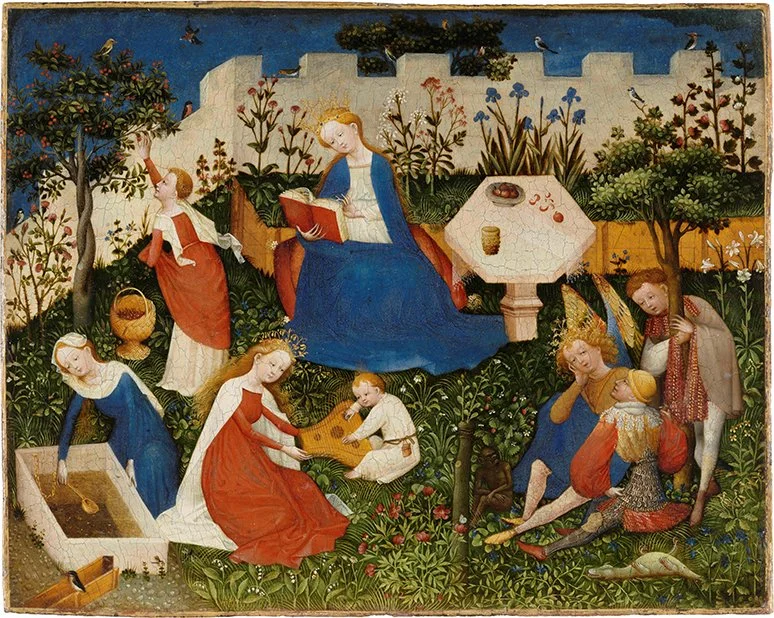
Das Paradies – ein Ort der Sehnsucht, der seit Jahrhunderten die menschliche Vorstellungskraft beflügelt. Als irdischer wie himmlischer Garten und als Sinnbild einer ursprünglichen Harmonie zwischen Mensch und Natur wurde er zum Projektionsraum für religiöse, philosophische und künstlerische Ideen. ‘Städel Museum, Frankfurt am Main’.
PER-SONAT
3-4 Sängerinnen, 2-3 Instrumentalist:innen (Fidel, Laute, Harfe)
Das Programm
entführt das Publikum mit Musik und Bild in die malerischen Gärten des 14. und 15. Jahrhunderts. Dabei meandern wir zwischen dem Paradiesgarten Salomons und dem Garten der Amors. Das vergnügliche Programm lässt uns musikalisch an den Höfen von Burgund, Paris, Mailand, Holland sowie Mainz und Ingolstadt verweilen und zugleich die Allegorien des Rosenromans wie auch die wunderbaren Bilder aus dem Hohen Lied Salomons erleuchten und lebendig werden.
Das Repertoire
Im Umfeld der burgundischen Hofkapelle von Philipp dem Guten, der italienischen Fürstenhöfe der Visconti und den Residenzen der Päpste von Avignon und Rom spannen wir einen musikalischen Bogen ausgehend vom Jahr 1380 bis zum Beginn der Renaissance um 1420. Es erklingt Musik von Gilles Binchois, Antoine Busnouys, Jacobus de Bononia und nicht zuletzt dem Star Guillaume Dufay, der am Hof des Burgunderherzogs Philipp des Kühnen tätig war.
In diesem Kontext betrachten wir Frauenlobs Marienleich als Rückblick ins Mittelalter und als Highlight deutschsprachiger Kunstmusik, welches mit Bildern aus längst vergangenen Zeiten spielt und virtuos mit den immerzu modulierenden Melodien, die in der Einstimmigkeit verhaftet bleiben, jedoch auf subtilste Art und Weise verschmelzen. Eine Zeitreise, die uns die Zeit vergessen lässt.
Welcome to Paradies
Devotion and Pleasure/Desire - Music between the Medieval and Renaissance Periods
Paradise – a place of longing that has captured the human imagination for centuries. As both an earthly and a heavenly garden, and as a symbol of the original harmony between humankind and nature, it has become a canvas for religious, philosophical and artistic ideas. ‘Städel Museum, Frankfurt am Main’.
The programme takes the audience, through music and paintings, on a journey to the picturesque gardens of the 14th and 15th centuries. In doing so, we meander between Solomon’s Garden of Paradise and the Garden of Cupids. This delightful programme allows us to linger musically at the courts of Burgundy, Paris, Milan, Holland, as well as Mainz and Ingolstadt, bringing to life the allegories of the Romance of the Rose and the marvellous imagery from the Song of Solomon.
The Repertoire
Drawing on the traditions of Philip the Good’s Burgundian court chapel, the Italian courts of the Visconti, and the papal residences in Avignon and Rome, we span a musical arc from the year 1380 to the dawn of the Renaissance around 1420. We perform music by Gilles Binchois, Antoine Busnouys, Jacobus de Bononia and, last but not least, the by the outstanding composer Guillaume Dufay, who served at the court of the Burgundian Duke Philip the Bold.
In this context, we regard Frauenlob’s Marienleich as a glimpse back into the Middle Ages and as a highlight of German-language art music, which plays with images from times long past and masterfully blends the constantly modulating melodies, which remain rooted in monophony yet merge in the most subtle of ways. A journey through time that makes us lose track of time.